
 العربية

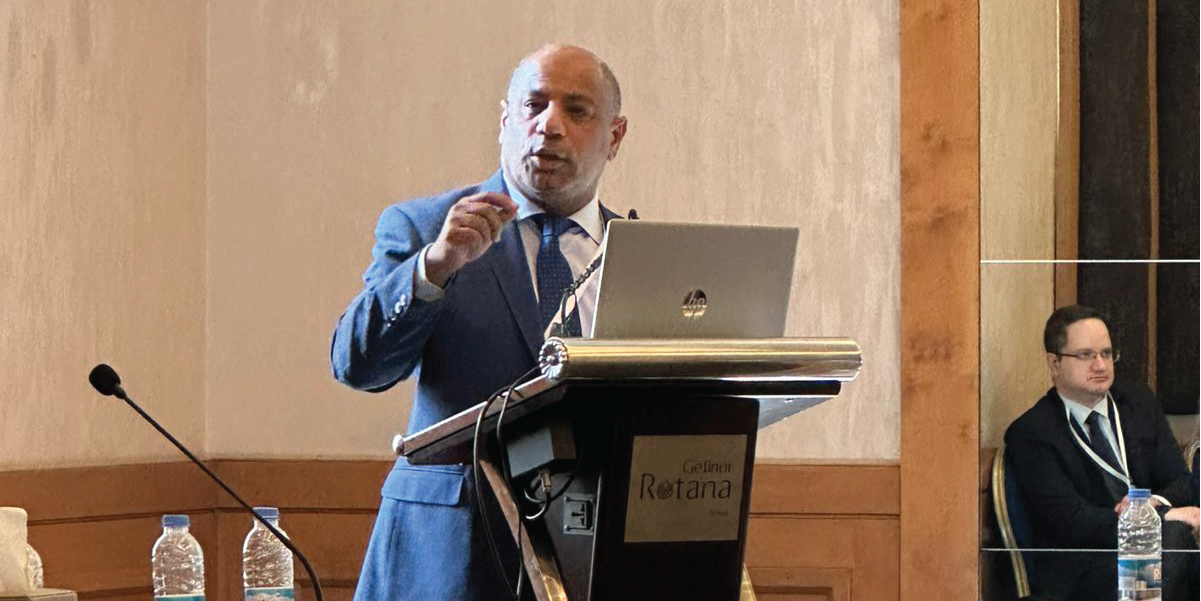
Dr Hamdan Al Fazari – Vice-Chancellor of Sohar University attended the 23rd International Conference of the Arab Academy of Sciences and presented a paper entitled “Fostering A Student Innovation Adaptive Learning Environment in the Digital Age in Higher Education in Arab States”. The conference was held in Beirut, Lebanon.
Dr Al Fazari started his paper by highlighting the importance of the conference theme. He then stated that the emergence of Artificial Intelligence (AI) onto the teaching and learning scene has exacerbated the need for forward-looking innovations to achieve adaptive learning tailor-made to each learner’s capabilities. He mentioned that adaptive learning immerses the student into the learning spaces using the constructivist approach. This approach emphasizes active student-centred learning (active learning) employing flipped classroom approach for an innovative and engaged learning environment. He further stated that adaptation is achieved by careful use of AI which acts as a learning analytics platform where the performance of students is analysed to come up with tailor-made adaptive learning systems. He added that his paper explores current interventions to encourage the proliferation of innovations promoting adaptive learning globally, with a special focus on the Arab States. He emphasized that using a systematic literature review approach, the paper explores the fundamental concepts of adaptive learning given the proliferation of AI-based technologies, investigates the different adaptive innovations that have been implemented in different parts of the world with a special focus in the Arab States.
Dr Al Fazari summarized his paper by stating that given the review of the varying contextual nuances, a framework is proposed which has potential of being a blue-print that can guide design and deployment of adaptive learning systems in the Arab States. The conceptual framework proposed by Dr Al Fazari may act as a blueprint that could influence design and deployment of adaptive innovative learning systems in the Arab World and in contextually-similar environments. This framework advocates for the design and implementation of sustainable scalable adaptive learning solutions which would move in tandem with evolving (emerging and future) technologies.