
 العربية

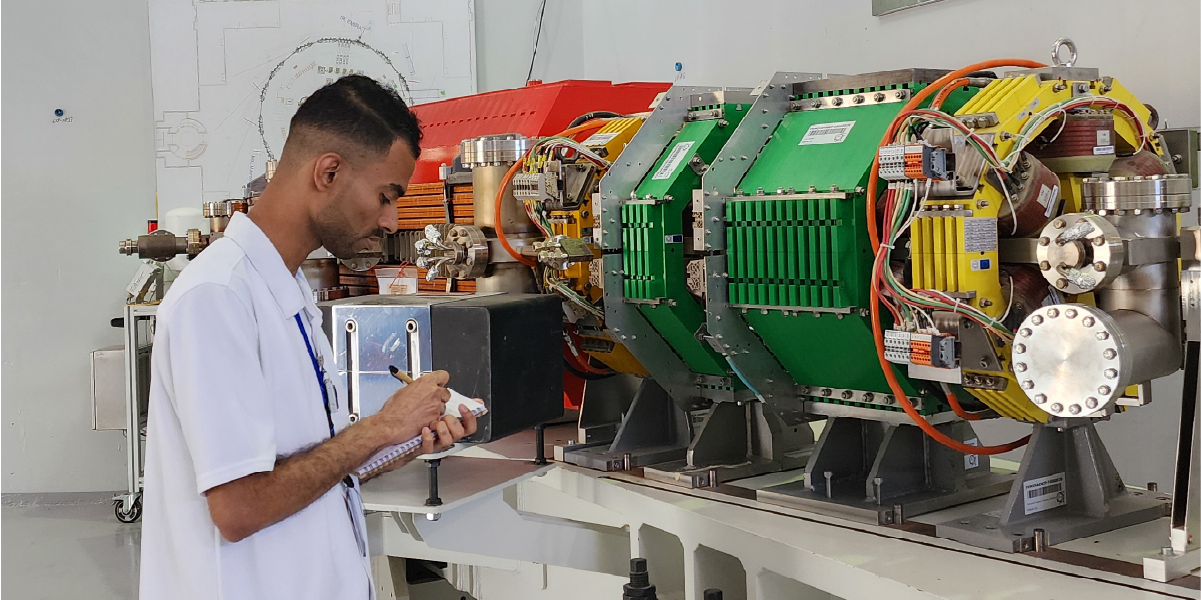
In a testament to empowering its students and providing high-quality training opportunities that enhance their research and technical skills, Sohar University has sent two students to participate in a specialized training program at the SESAME (Synchrotron-light for Experimental Science and Applications in the Middle East) research center in the Hashemite Kingdom of Jordan. The two students, Alwaleed Al Isaei, a software engineering student from the Faculty of Computing and Information Technology, and Khalid Al Shizawi, a student from the Faculty of Engineering, were chosen for their academic excellence and for achieving distinction grades.
The program is an intensive training that enables students to gain advanced practical experience and enhances their skills through their involvement at an international research center.
During his first two weeks, Alwaleed Al Isaei completed his technical training with the Control team, applying what he learned at the university about systems such as Rocky Linux. He also acquired new skills in linking virtual machines and transferring information and was trained on the Git Version Control system for managing software projects.
In a remarkable achievement, Alwaleed programmed a Python application that connects to the EPICs system, a vital system for developing control systems in research centers, which allows the user to move motors to specific values.
Regarding his experience with the data collection team, Alwaleed noted that he learned the basics of OpenCV and designed programs that identify and recognize faces, in addition to a program that locates cars using YOLO technology. Alwaleed emphasized his integration into a project to develop a machine learning system for the robotic arm in materials science, with the aim of facilitating its use for researchers. He expressed his deep gratitude to the university and the SESAME center for this “unique” opportunity, praising SESAME as “the only center in the Middle East that generates synchrotron light using an atomic accelerator,” and affirming his enjoyment of linking his specialization in software engineering with the technologies available there.
Student Khalid Al Shizawi also spoke about the academic and personal benefits he gained. Academically, he noted that this opportunity allowed him to interact directly with researchers and workers in the sector, which made it easier for him to acquire information and apply his theoretical studies in practice. He also emphasized that he gained experience in dealing with machines and devices, developed his ability to share ideas and receive feedback from specialists, and worked effectively within an integrated team. This helped him develop communication and adaptation skills, and how to think better to solve technical and practical problems.
On a personal level, Khalid described this experience as “unique” as it was his first trip entirely on his own. He noted that he learned to rely entirely on himself in managing time and money and how to deal with others while taking into account intellectual and cultural differences. He also stressed the importance of being able to represent his country and highlight Omani traits and values. Khalid thanked the SESAME center for hosting him and providing him with knowledge, and Sohar University for providing these opportunities that reflect its concern for its students and its continuous initiative for progress.
SESAME is a collaborative scientific research center that was officially opened in May 2017 under the patronage of UNESCO. The center enables researchers from the Middle East and beyond to conduct advanced research in various disciplines, including medicine, biology, materials science, physics, chemistry, engineering, environmental science, and archaeology.
This initiative is part of Sohar University’s vision to open up to prestigious scientific institutions and provide an applied educational environment that enriches its students’ knowledge in advanced fields such as radiation physics and modern laboratory techniques, which enhances the university’s commitment to developing qualified alumni for the future.